Multi-Threshold Byzantine Fault Tolerance
Paper: [1]
Overview
This is a Byzantine Fault Tolerant SMR Protocol where the standard \(t
Constraints Summary
The following constraints always hold since synchrony assumptions are stronger than asynchrony assumptions:
- \(\beta_a \le \beta_s\)
- \(\gamma_{a} \le \gamma_{s}\)
This work also focuses on the \(\gamma<\beta\) case, i.e., safety is more important than liveness.
Notes
- It is an SMR protocol.
- It works in both the synchronous and partially synchronous network model.
- It uses the non-lock step network model.
- It is adaptively secure.
- It seems that the number of safety and liveness faults can intersect.
- In this paper, it is not clear what the definition of "safety" fault is. Can it send blame messages when it is time to propose? Is safety + liveness fault = a Byzantine fault? If not, why is it a generalization of the \(t
- I think the protocol assumes a clock synchronization protocol. It is unclear whether the clock synchronization protocol exists in this multi-threshold model?
RBC Definition
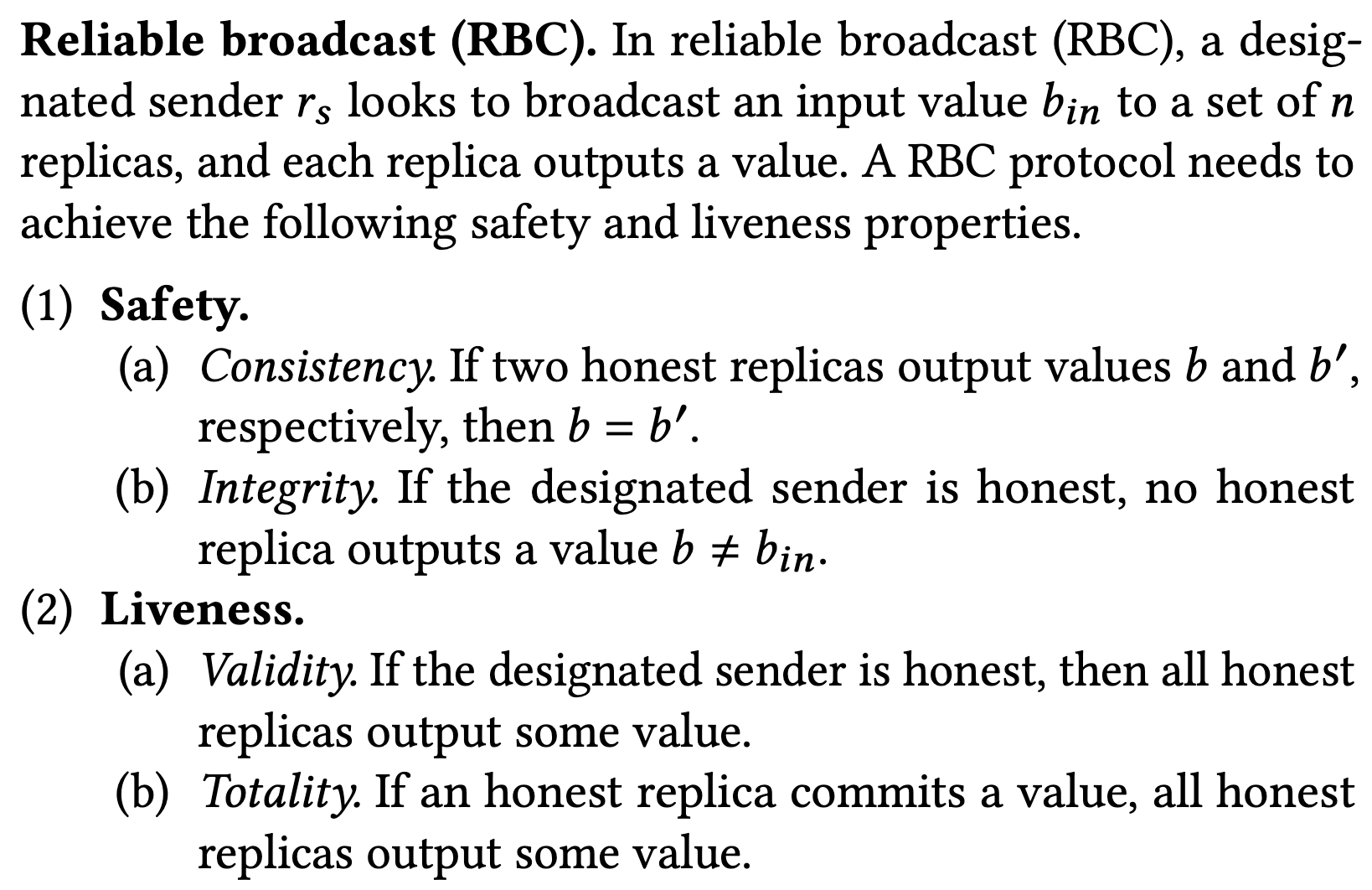
Reliable Broadcast can be achieved if and only if \(2\gamma_s+\beta_a < n\)
Proof theorem
Proof by lower-bound in the sync-psync timing model for the RBC problem.

Proof
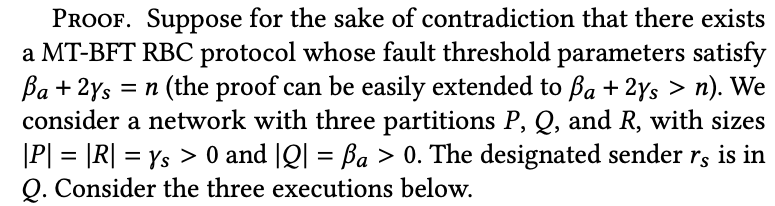
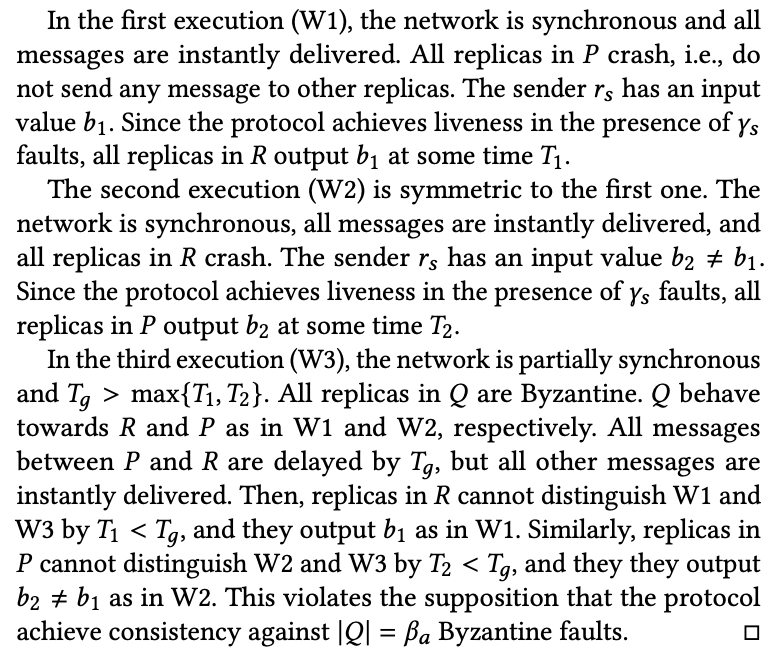
My understanding

Optimal protocol with \(\beta_{a}+2\gamma_{s}\lt n\), \(\beta_{s}\lt n\), \(\gamma_{s} \lt n/2\) and \(\gamma_{a}<\min{\beta_{a},\gamma_{s}}\)
The protocol
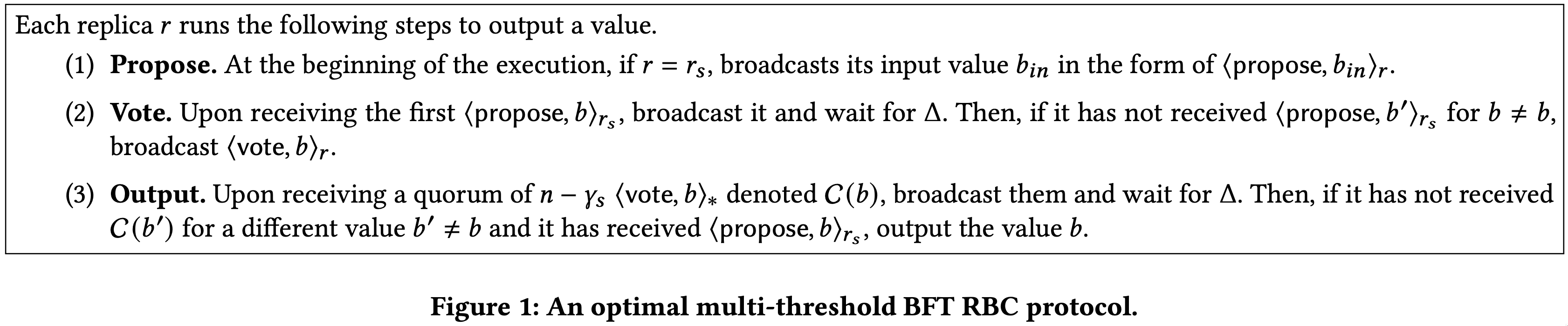
We need to use quorum size of \(|C|=n-\gamma_{s}\)
- Since the protocol needs to be live in both synchrony and asynchrony, we need \(|C|<=n-\gamma_{a}\) and \(|C|<=n-\gamma_{s}\)
- Since \(\gamma_{s} > \gamma_{a}\), we have the optimal quorum size of \(|C|=n-\gamma_{s}\)
- We also need to ensure that a quorum certificate is unique for a value. So we get \(n-\gamma_s+n-\gamma_s > n\implies \gamma_{s} < n/2\)
The quorum size of \(|C|=n-\gamma_s\) ensures validity
- All we need in the validity property is that some value is output by the protocol
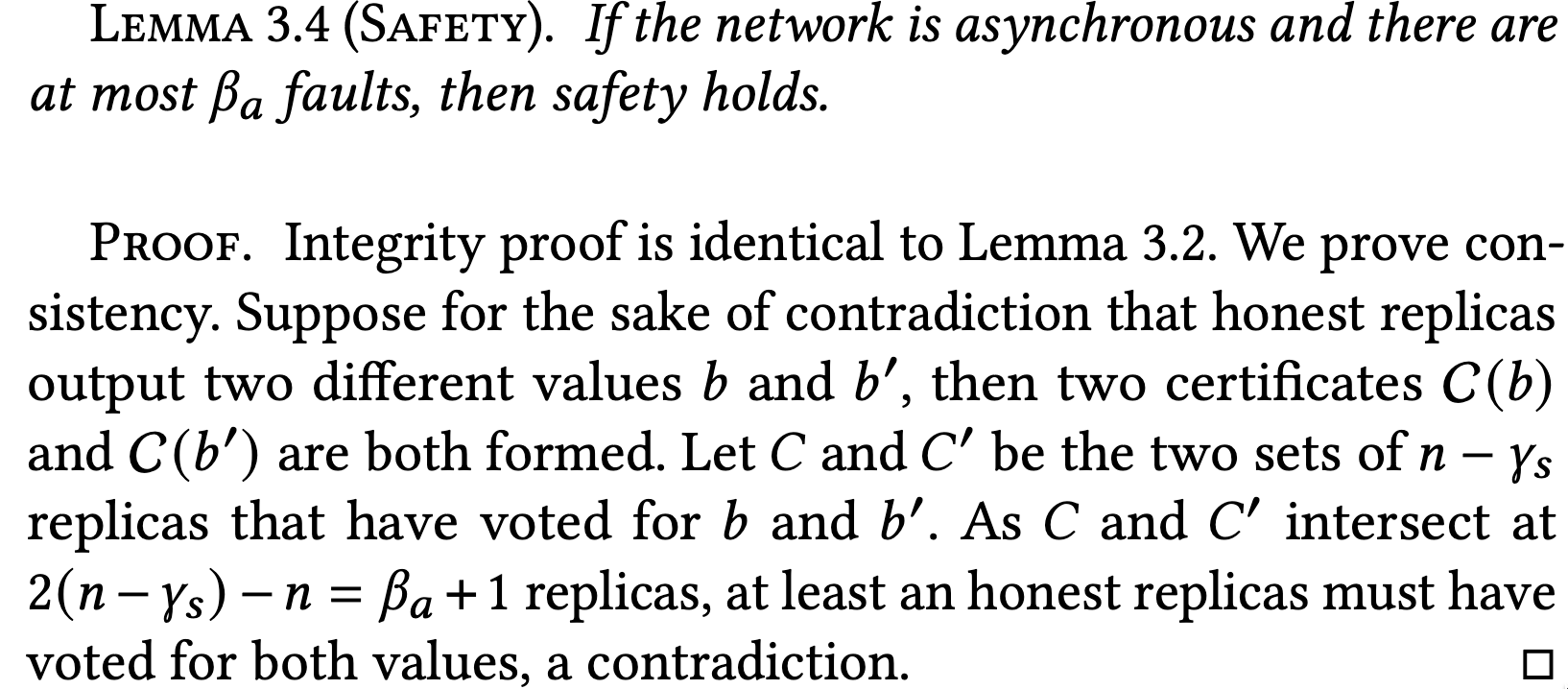
Asynchronous quorum intersection needs \(\beta_{s}+2\gamma_{s} < n\)
- Asynchronous quorum intersection needs to prevent existence of alternate certificates
- \(n-\gamma_s + n-\gamma_{S} > n+\beta_{a}\implies n-2\gamma_{s}>\beta_{a}\) or \(\beta_{a}+2\gamma_{S} < n\)
Synchronous quorum intersection needs \(\gamma_{s} < n/2\) and \(n-\gamma_{s} > \beta_{s}\)
- Since \(\gamma_s < n/2\), \(n-\gamma_s > \beta_{s}\) contains at least one honest node.
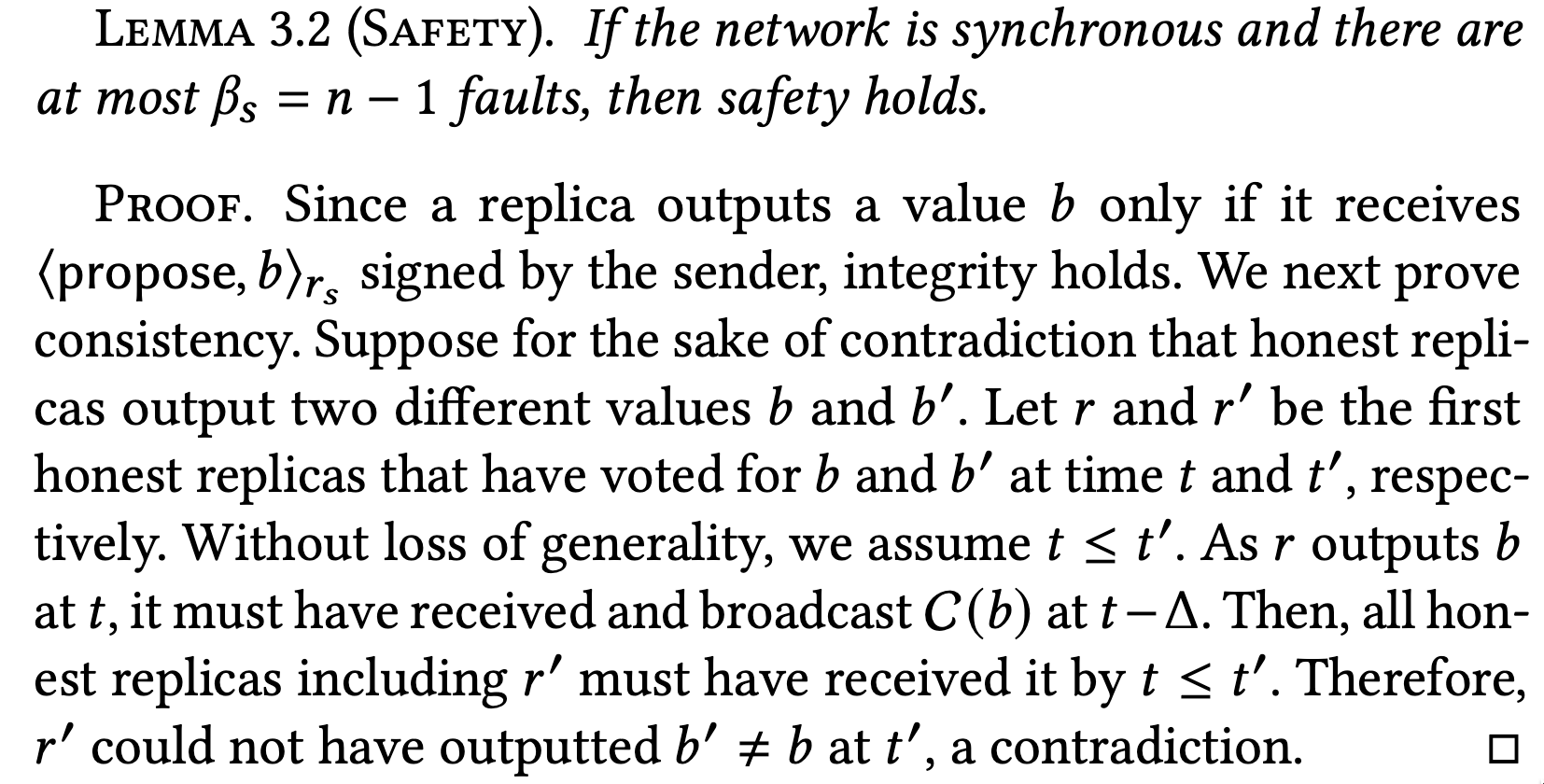
- The protocol uses two equivocation checks. First on the proposal and second on the certificate. The second equivocation check works for any \(\beta_{s} < n\).
- When \(\beta_{s} < \gamma_{s}\), no conflicting certificates exist.
Synchrony safety proof
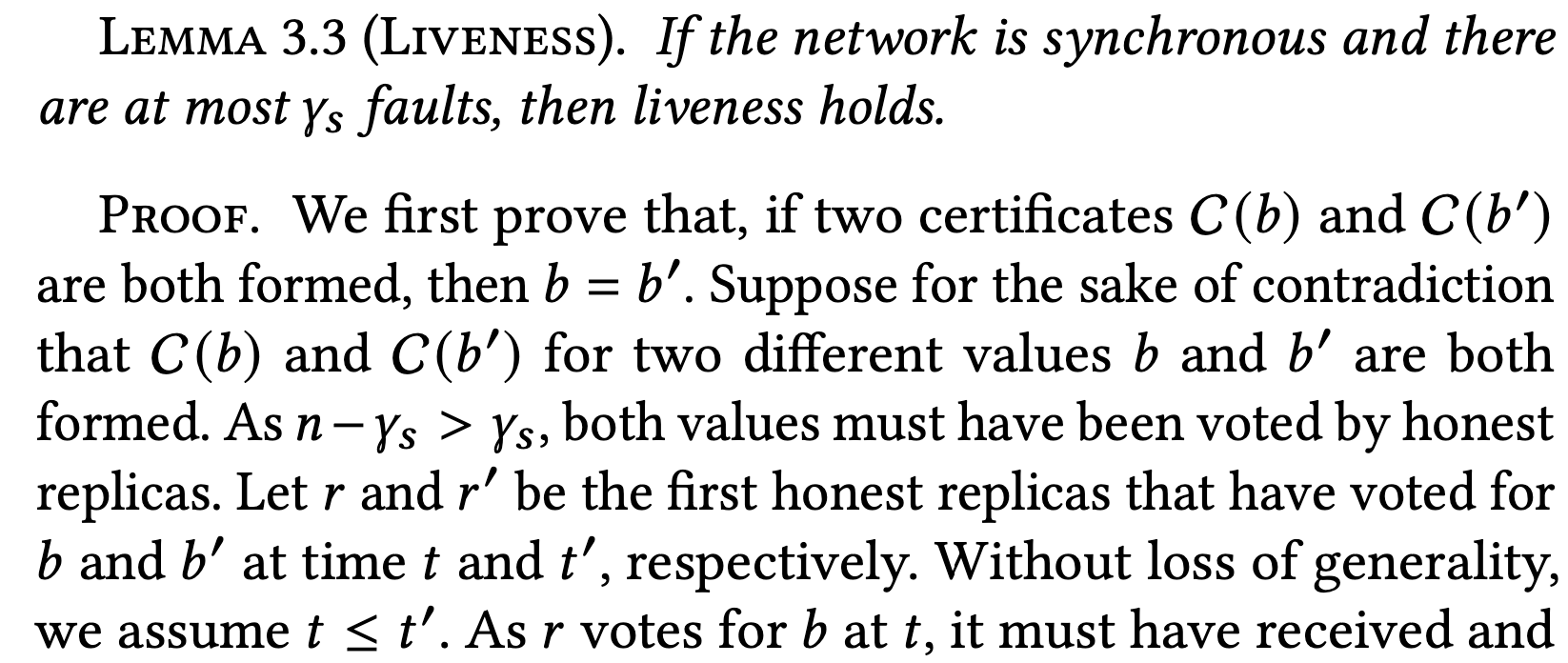
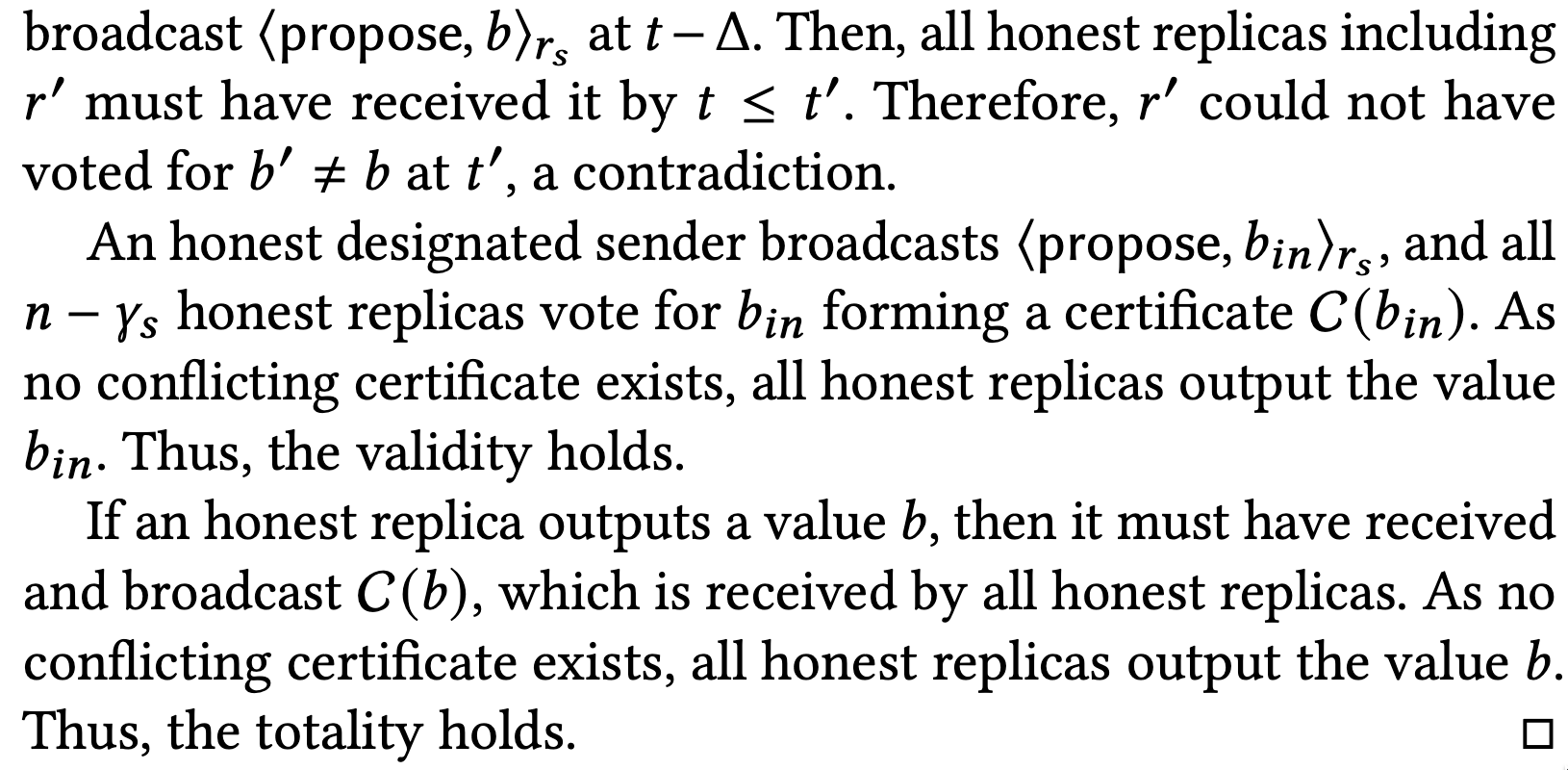
Synchrony liveness proof (DID NOT UNDERSTAND)
Asynchrony safety proof
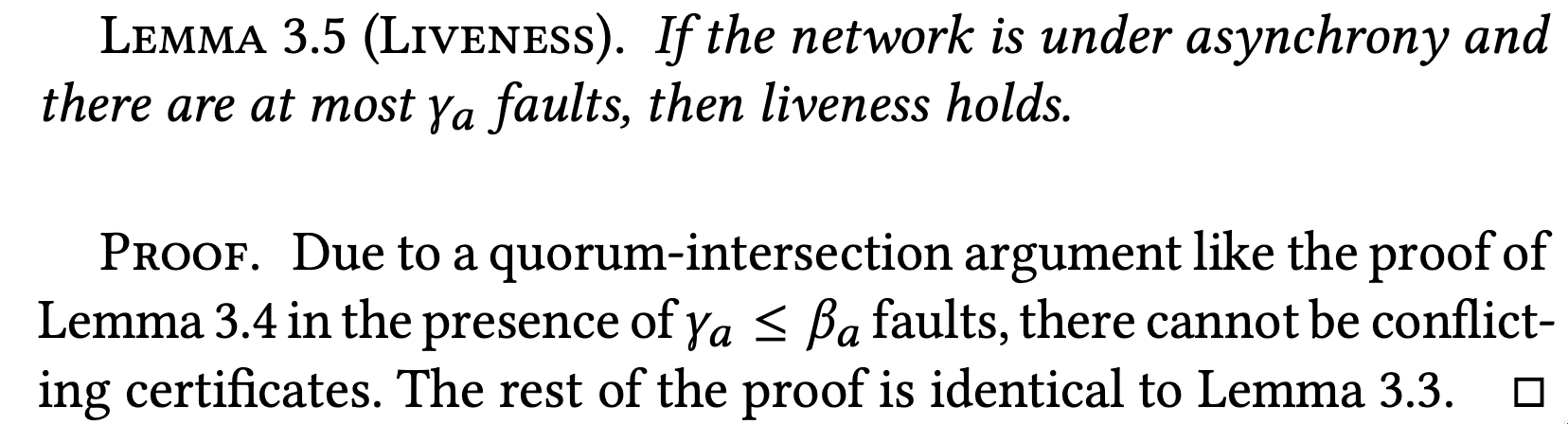
Asynchrony liveness proof
Metrics
- Latency is \(2\Delta+2\delta\)
- Communication complexity is \(O(n^{3})\) w/o threshold signatures
MT-BFT SMR with Public verifiability needs \(\beta_s+\gamma_s \lt n\) along with the RBC bound
- Same bounds as RBC + a bound for public verifiability
- Bound for public verifiability by showing bound for Publicly verifiable RBC (PVRBC)
Proof theorem

Proof
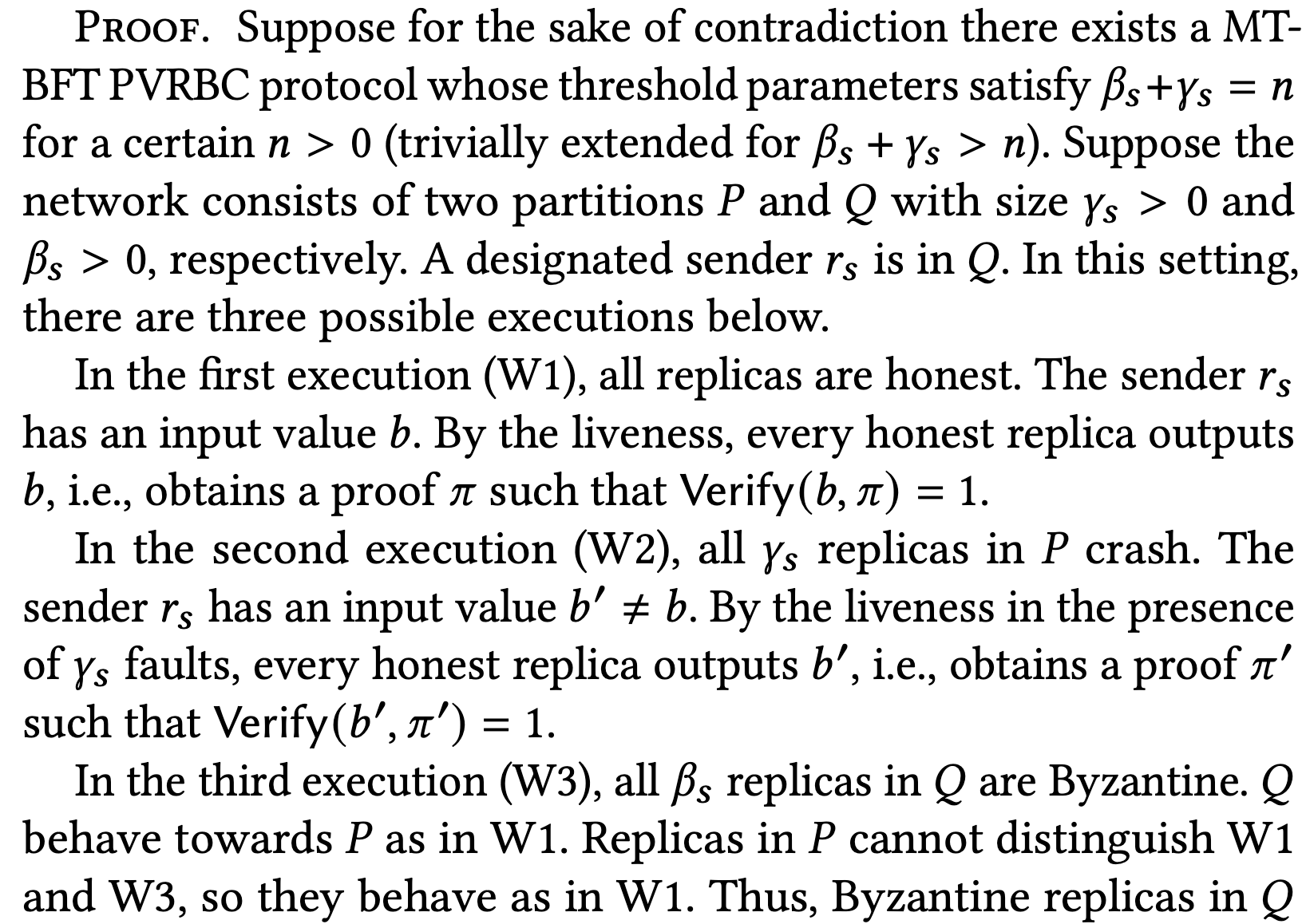
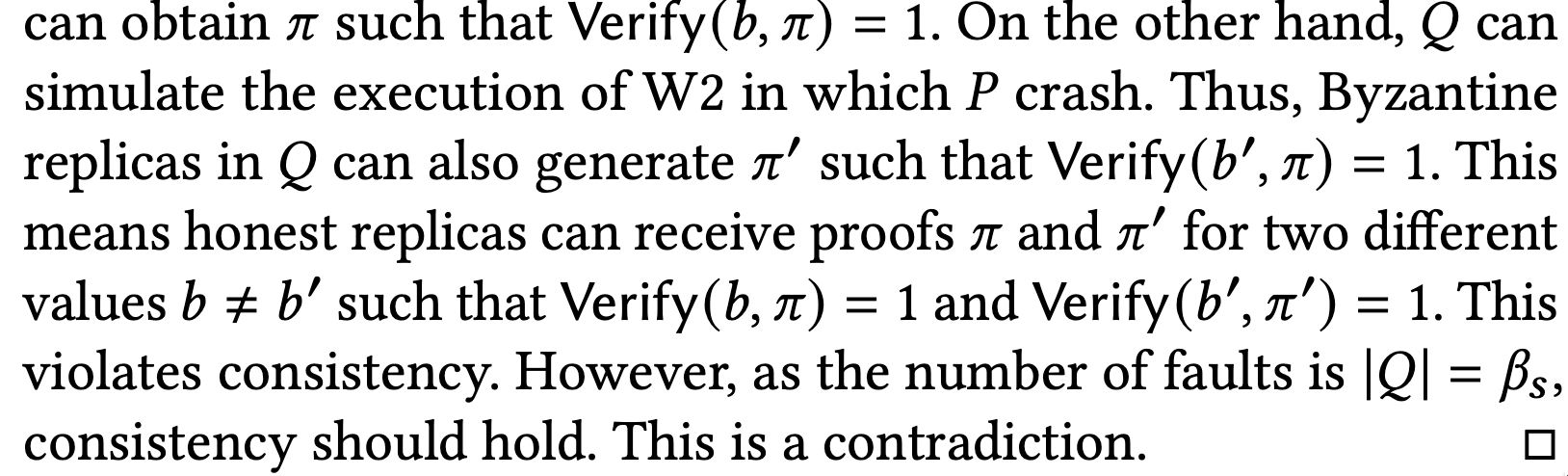
My understanding of the proof

A concrete protocol with \(\beta_s<\frac{2n}{3}\) and \(\beta_{a}=\gamma_{a} =\gamma_{s}=\frac{n}{3}\)
Protocol

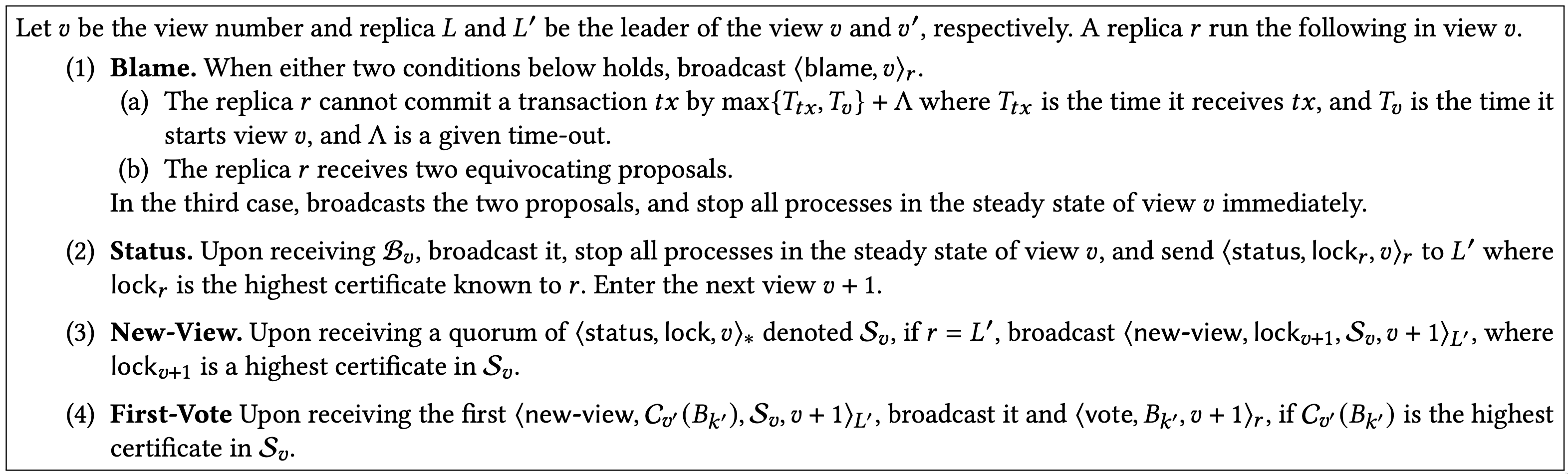
A framework to upgrade to optimal synchronous safety
Typos
- Page 4, "Synchronous equivocation-checking", repica
- Section 4.1 use of \(\beta_{s}+f_{s} < n\) instead of \(\beta_{s}+\gamma_{s} < n\) in two locations
References
[1] Atsuki Momose, and Ling Ren. 2021. “Multi-Threshold Byzantine Fault Tolerance.” https://doi.org/10.1145/3460120.3484554.